Town of St. George – Coastal Resiliency Project
Using cutting-edge 3D modeling and immersive visualization, we empowered the Town of St. George and its residents to understand, plan, and prioritize coastal resiliency strategies to address the impact of rising sea levels.
Location
St. George, Maine
Sector
Municipal
Services
- Surveying & Geomatics
- Planning & Permitting
- Environmental Services
- Civil Engineering
- Landscape Architecture
Completed
Initiated in 2020 (Ongoing)

THE CHALLENGE
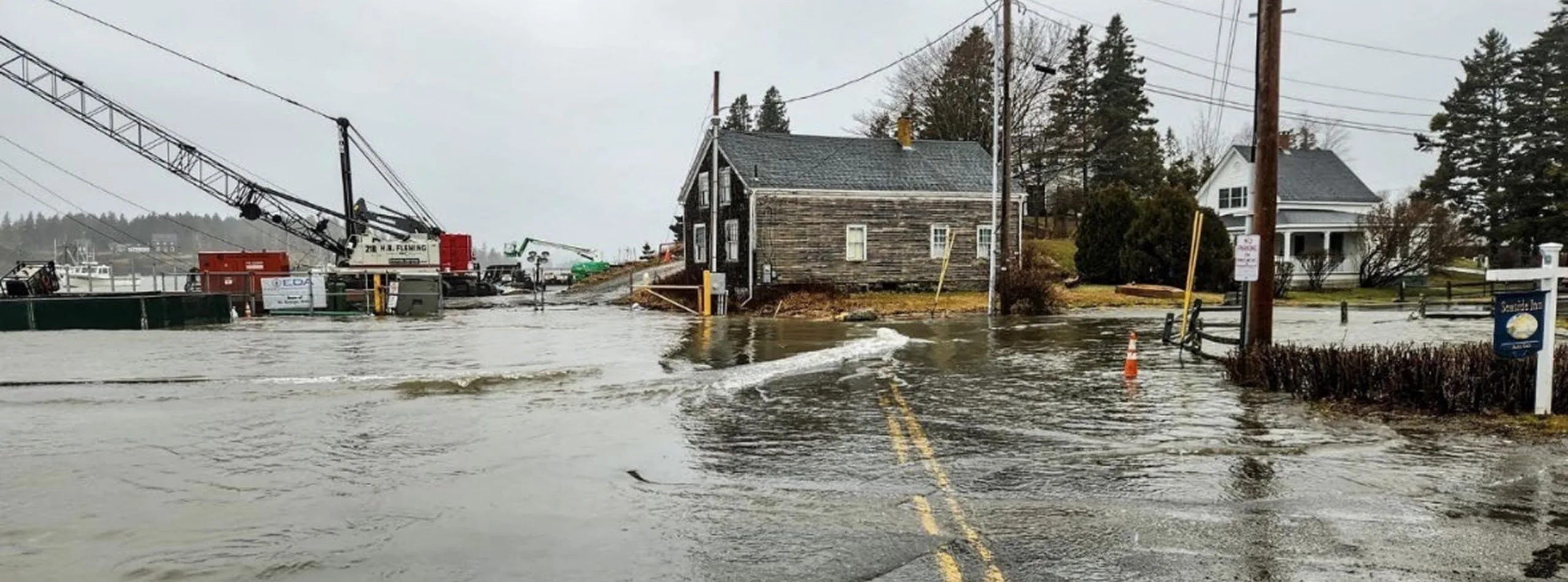
Rising sea levels pose an ongoing threat to St. George’s 125-mile coastline, endangering roads, public and private property, and critical community assets.
Proactive, forward-looking planning was essential, but with a limited municipal budget and constrained technical resources, the Town needed an innovative partner with deep regional experience and the ability to scale smart solutions for a small coastal community.
Securing buy-in from town leadership and residents was critical. To achieve this, complex environmental data had to be transformed into clear, accessible information that the entire community could understand. The project required collaboration across generations, informing those making the decisions today and teaching those making decisions tomorrow, delivering immediate insights and building a long-term vision for resilience.


Approach, continued
A community project
Sebago assembled a multidisciplinary internal team spanning Survey-Geomatics, Civil Engineering, Planning, and Landscape Architecture to ensure the work reflected both technical precision and a diversity of perspectives. We also led a consortium of partners who contributed over $120,000 in in-kind services. These collaborators—VCTO Labs, SEARCH, Colby College, the Gulf of Maine Research Institute, and the Midcoast Council of Governments—brought deep scientific, cultural, and regional insight, ensuring that the strategies developed were not only innovative but also deeply rooted in the community’s needs and character.
To establish trust, we implemented a comprehensive education strategy centered on immersive, data-driven modeling. Using sUAS-based LiDAR, bathymetry, and photogrammetry, we created centimeter-accurate 3D models of eight vulnerable coastal sites. These high-resolution digital replicas became the foundation for an interactive virtual environment, allowing residents, officials, and project partners to truly visualize the future impacts of rising sea levels.
At community events held in the St. George School gymnasium, Sebago brought together residents, officials, and students to explore the 3D models and visualizations of future plans. Involving the youth from the community was intentional. They brought fresh, unbiased perspectives and a sense of ownership for the long-term outcomes. Their curiosity sparked new ideas and energized discussions. By integrating their voices, the community prioritized projects based on real needs and future impact.
Building on this momentum, Sebago developed a series of models illustrating sea level rise scenarios through 2100. These projections became the foundation for a planning charette, where Town officials and community members gathered at Sebago’s office to collaboratively explore what the data meant for St. George and how to strategically prepare for the challenges ahead.




The Results
Adaptable resilience
The project’s impact was both immediate and far-reaching. The high-resolution 3D models depicting sea level rise scenarios allowed stakeholders to visualize vulnerabilities, prioritize solutions, and understand the scope of potential change. These immersive digital tools, paired with virtual reality experiences, made the complex science behind climate resilience accessible to all, from lifelong residents to middle school students.
The collaborative, community-first approach went beyond infrastructure. Together, we helped preserve the region’s historical and archaeological treasures, prompted productive budget planning for future mitigation work, and revealed how adaptable tools like digital modeling could serve multiple needs, such as aiding in documenting buildings lost in a Port Clyde fire. Sebago also worked alongside the Town to identify funding and grant opportunities, recognizing the critical role resource allocation would play in bringing long-term solutions to life.
That planning is already proving effective. Based on the vulnerability assessment and priority areas identified through this work, the Town of St. George secured funding to begin engineering and design for Priority Area #1, Cold Storage Road and Factory Road, the primary access routes to the heart of the village and several essential services. Sebago Technics was selected to lead this next phase, continuing the work of assessment, engineering design, and community engagement. It’s a clear demonstration that the plan we helped shape is not just visionary, but actionable.
Our work with St. George established a new benchmark for coastal resiliency planning—uniting cutting-edge technology with authentic public engagement. The model developed here is not only replicable across Maine’s 3,478 miles of coastline but also serves as a roadmap for small coastal communities worldwide. ClimateWork Maine honored the project with the 2025 Climate Innovation Award, praising it for offering a practical and scalable methodology that could benefit every town along the state’s shoreline.
At Sebago Technics, every project begins with a commitment to building relationships rooted in confidence, collaboration, and open communication. The St. George Coastal Resiliency Project stands as a testament to that dedication. By equipping the Town with advanced tools, meaningful insights, and professional perspectives, we helped empower local leaders and residents to make informed decisions about their future and protect their coastline.
Key Takeaways
Related Case Studies
See how we transform plans into impactful places across the region.


